What does that error code mean?
Find your brand, your appliance and your code — and what to check first. Free, no sign-up.
Free reference · No sign-up · Every meaning checked against the manufacturer's own documentation
Find your brand, your appliance and your code — and what to check first. Free, no sign-up.
Free reference · No sign-up · Every meaning checked against the manufacturer's own documentation
We publish one brand cluster at a time and finish it properly before moving on.
Washing machine error codes covered in full — all 17 code families in one reference table, 15 with a complete guide of their own.
Only what is actually published — no empty category pages.
Samsung error codes hub — 15 code guides and 3 symptom guides, each a full page of its own.
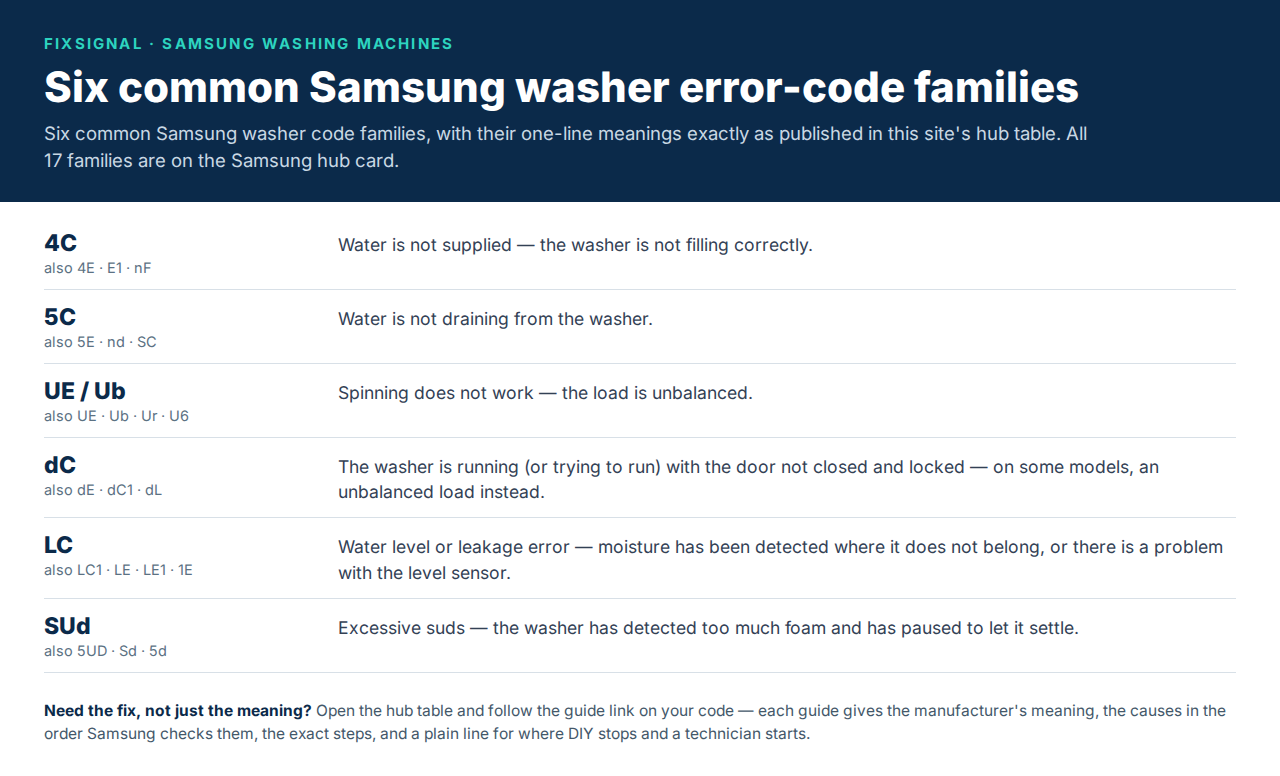
The Samsung washer codes people look up first. Older displays often show a different form of the same fault — 5E is 5C, and dE belongs to the dC door family.
Six common Samsung washer code families, each with its one-line meaning — drawn from the hub table. The full 17-family card sits on the hub itself, next to the complete table.
Three steps: brand, code, fix.
Start from the brand hub — Samsung washing machines are live now, complete.
Displays vary by model, so every page lists the code's other forms (4C is also 4E, E1, nF). Search matches them all.
Each guide gives the causes in the order the manufacturer checks them, the exact steps, and a plain line for where DIY stops.
Not sure the code is the whole story? Match what the machine is doing.
Emergency drain, debris filter, hose checks, and the pump hum-versus-silent fork.
Never spins, spins too slowly, or stops with a code — three different problems, three different fixes.
The beep pattern is the diagnosis: end-of-cycle chime, door alarm, code announcement, or stuck button.
Every Samsung washer guide was reviewed in November 2026 — meanings and check orders checked against Samsung's current support documentation.
Water is not supplied — the washer is not filling correctly.
Spinning does not work — the load is unbalanced.
The washer is running (or trying to run) with the door not closed and locked — on some models, an unbalanced load instead.
Very hot water is arriving through the cold inlet — the hot and cold supply hoses are reversed.
Water level or leakage error — moisture has been detected where it does not belong, or there is a problem with the level sensor.
Excessive suds — the washer has detected too much foam and has paused to let it settle.
Overflow error — there is too much water in the washer.
Motor Driving Error — the motor is having difficulty operating. On some models, 3E is a voltage error instead.
Not a fault code — the Child Lock display. On newer models it appears after Child Lock has drained the tub because the door was opened with water inside.
Voltage error — the washer measured the electrical supply outside its safe range. PF is the family's record that power was interrupted.
Water level sensor issue — documented differently by Samsung region; your model's manual takes priority.
Communication error — the main control board and the sub (display) board have stopped communicating.
Temperature sensor error — the sensor's reading cannot be trusted, so the machine will not heat on a guess.
On most models, a jammed panel button (bE1/bE2/bE3) — but a sensor error on some models; behaviour tells you which.
Manufacturer first. Every meaning, figure and wait time on this site is checked against the manufacturer's official support documentation, and the exact Samsung pages are linked at the foot of every guide. One code, one page — no mega-lists to scroll. Model differences stated — where a code means two things on two model families (dC is the famous case), we print the table instead of telling you to “check your manual.” A DIY-stop line on every page — what is safe, what is technician-only, and what the repair actually involves.
FixSignal is independent — not affiliated with Samsung or any manufacturer. We publish a code only when we can add the full procedure, the model differences and the safety framing; that is why the heater code HE is not here yet. Corrections are welcome at any time via the contact page, and our full method is on the editorial policy page.